
Leading Interior Design Supervision in Jordan: Scope and Responsibilities
What site supervision should include, what remains the contractor’s responsibility and how written reporting protects design decisions.
Leading Interior Design Supervision in Jordan: Scope and Responsibilities
Site supervision is one of the most misunderstood services in the Amman construction and fit-out market. Clients sometimes expect a supervising designer to manage the workforce, enforce safety on site or guarantee a defect-free handover. Contractors sometimes expect a designer to stay off site entirely. Neither expectation reflects what professional design supervision actually covers. This guide explains the scope, the visit structure and the limits of the service as Stones Jordan® provides it in Amman.
What Interior Design Supervision Covers
Design supervision means a qualified designer visits the site at agreed intervals to review visible work against the approved design documentation. The reviewer checks whether what is being built matches what was designed and specified. That is a narrower scope than general construction management, and it is deliberate.
At Stones Jordan®, supervision is offered as a distinct phase following design and space planning, finishes selection and contractor coordination. The company has operated from its Dabouq studio since 2000 and carries out site supervision exclusively in Amman. Projects in the Gulf are handled through design, documentation and remote project management, with photo and video reporting to clients who follow progress from abroad.
Supervision visits typically cover:
- Dimensional checks: room proportions, ceiling heights, door and window positions against approved drawings
- Material verification: confirming that delivered and installed materials match approved samples and specifications
- Finish quality: reviewing tiling, joinery, paintwork and stonework for visible defects or inconsistencies
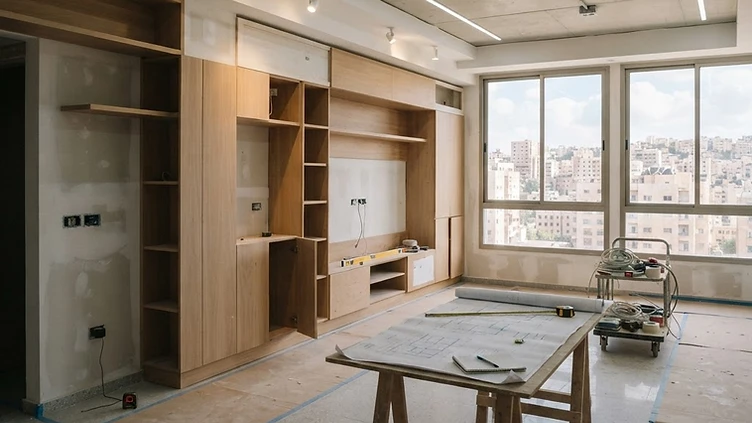
- Detail coordination: checking that lighting positions, socket locations and built-in furniture align with the design layout
- Contractor queries: logging and responding to requests for information before installation proceeds
- Deviation recording: documenting any substitution or change that differs from the approved design, with photographs
What Supervision Does Not Cover
This distinction matters legally and practically in Jordan. The contractor remains solely responsible for construction methods, structural decisions, labour welfare, site safety and physical execution. Unless a contract explicitly transfers those duties, the designer's role does not extend to them.
Supervision visits observe what is visible at the time of the visit. Work completed and concealed between visits is not retroactively reviewed. This is why visit frequency, agreed in writing before work begins, affects the depth of oversight the client receives.
Supervision is also not a substitute for a qualified structural or MEP engineer. If mechanical, electrical or plumbing installations require technical sign-off, that responsibility belongs to the relevant specialist.
How Visit Frequency Is Agreed
Before construction begins, the supervision agreement should state the number of visits per week or per phase, what each visit covers and how findings are reported. For an Amman apartment, which typically moves from design to handover in two to four months, weekly visits during active fit-out phases are common. Villas and larger commercial projects usually require a more frequent schedule during critical phases such as joinery installation or stonework.
The agreement should also define how urgent decisions are handled between visits. A contractor who needs a quick answer on a material substitution should not have to wait until the next scheduled visit. Stones Jordan® uses documented decision logs and direct communication to keep the contractor moving without bypassing design intent.
What Each Supervision Visit Checks
A structured visit follows the work sequence on site rather than moving randomly through rooms. The reviewer works from the approved drawing set and the last visit report, so deviations from previous observations are caught before they compound.
For completed projects like the Contemporary Duplex with Roof Terrace in Amman or the Modern Flat in Amman, consistent site review during fit-out was part of aligning the finished result with the design intent across materials, proportions and detailing.
Each visit produces a written record noting what was observed, what deviates from approval, what action is required and who is responsible. That record is shared with both the client and the contractor. For clients based in the Gulf who are managing an Amman project remotely, this documentation becomes the primary way they track progress and maintain confidence in the process.
The Role of Timely Decisions
Supervision depends on decisions being made before installation, not after. When a contractor proposes a material substitution, presents a sample or raises a technical question, the designer needs adequate time to review it against the approved specification and respond clearly.
Delayed decisions are one of the most common causes of cost increases and programme slippage on Amman fit-out projects. Building in a structured submission and review window, usually three to five working days for standard items, keeps the site moving and reduces the risk of installed work needing to be removed.
Supervision and Contractor Coordination
Design supervision and contractor coordination are related but distinct. Coordination involves briefing contractors before work begins, issuing revised drawings and ensuring subcontractors understand the design intent. Supervision is the on-site verification that follows. Both services are more effective when they are managed by the same team, since the designer who coordinated the brief is best placed to identify deviations from it.
For apartment interior design in Amman or villa projects, having a single point of contact who manages both the design documentation and the site review reduces the gap between what was specified and what is built.
How to Start
If you are planning an interior fit-out or renovation in Amman and want to understand how supervision would apply to your project, the first step is a conversation. Stones Jordan® offers a free first consultation to review your project, timeline and scope. There is no obligation, and the discussion will give you a clear picture of what a structured supervision arrangement would cover, what it would exclude and how it fits into the broader design and delivery process.